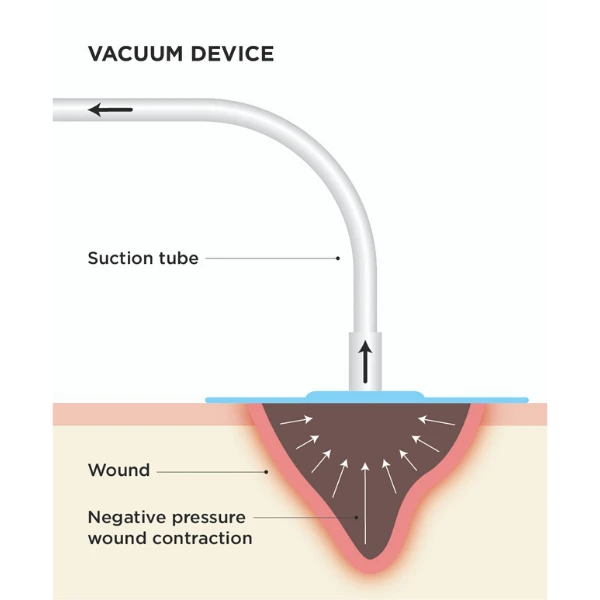
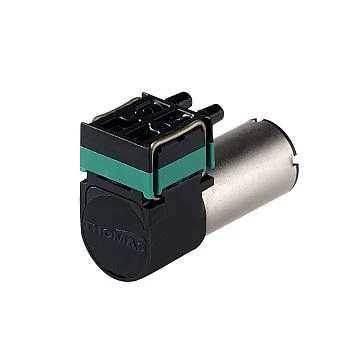
The main components of NPWT devices are the NPWT dressing itself and a vacuum pump to control wound management and wound care settings. The wound dressing, which is connected to the vacuum pump, is applied to the affected area.
Vacuum is applied and maintained through the specially sealed dressing. Depending on the type of wound and treatment plan the vacuum may be applied continuously or intermittently.
A range of pressure wound therapy devices are available with different capacities and dressings to tailor the type of wound and therapy.
Thomas Pumps for NPWT
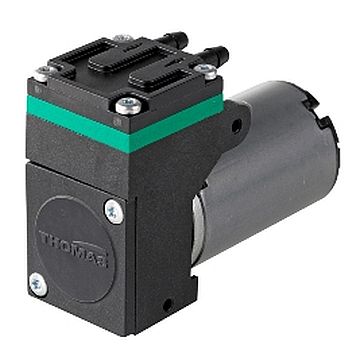
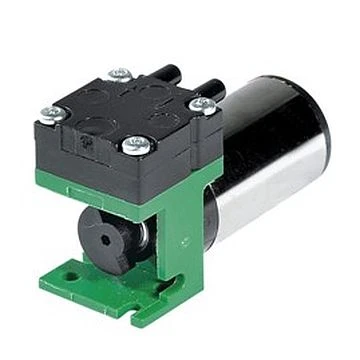
Several product lines within the Thomas standard portfolio are well suited for the Negative Pressure Wound Therapy application. Thomas pumps meet general market needs and, more importantly, can be modified to meet specific customer requirements.
The modular system of our diaphragm pumps allows for modifications to the pneumatic performance by utilizing different eccentrics and/or by controlling the applied motor speed. Controlling the individual working point of the pump allows for control of the respective vacuum level applied to the wound.
Different elastomers and plastics for all wetted components increase the chemical compatibility of the pump. Typical materials for the elastomers are EPDM or Viton (FKM). Pump head materials can be as diverse as IXEF or Ryton.
Selecting the correct motor is key for the pumps efficiency and overall lifetime. Almost all the Thomas product lines offer low cost DC, standard DC, or high-end BLDC motors. The start/stop behavior of the motor chosen dictates the total number of cycles attainable. This has a direct influence on the overall lifetime of the NPWT device.
Key NPWT Pump Features and Benefits
Thomas pumps are engineered to meet OEM’s specification of NPWT devices with special attention to the following pump characteristics:
- Compact and lightweight design to improve patient mobility
- Low sound and vibration level to enhance patient comfort
- Energy efficient set-up for prolonged battery life
- Broad range tailored for acute, chronic or single-use applications
In terms of performance, our diaphragm pumps provide typical vacuum levels ranging from 45% for the 1014 product family up to 78% for the 1420 product group. Corresponding free flow values are 0.023 cfm (670 ml/min) in the 1014 Series up to 0.388 cfm (11 l/min) in the 1420 Series.
Typical vacuum levels range from 45% for the 1014 product family up to 78% for the 1420 product group. Corresponding free flow values are 670 ml/min (1014 Series) and 11 l/min (1420 Series).
THOMAS
Thomas continues to set the standard for pumps used in negative pressure wound therapy.
By combining the efficiencies and operating characteristics of positive displacement diaphragm technology with lightweight chassis materials, we are able to meet the challenges of an evolving market for compact medical equipment. Our ability to introduce products to keep pace with market demands is key to our success.